 Proudly Canadian

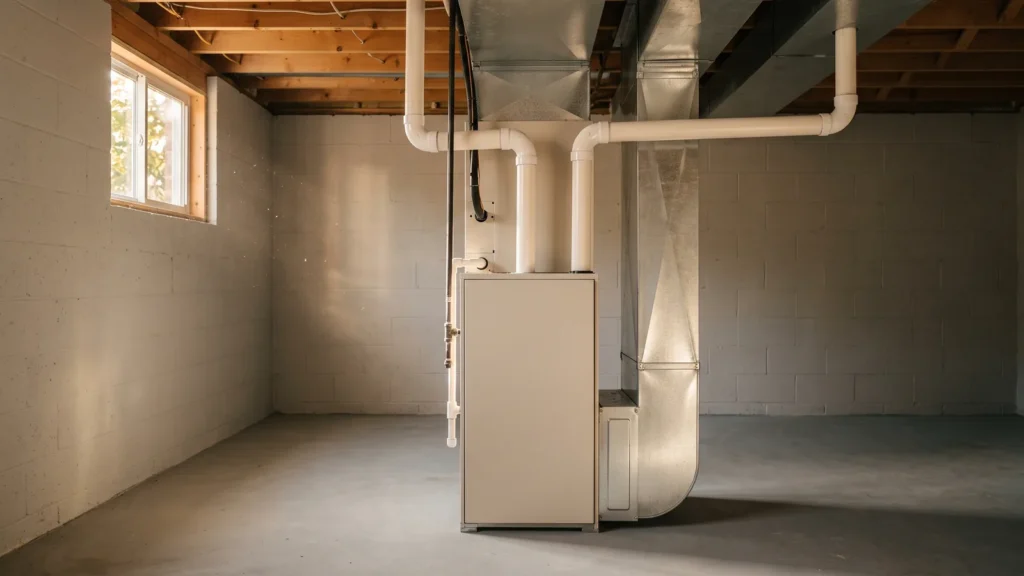
Ottawa gives you a short window. The last warm week of September feels like summer is hanging on, and then one night the temperature drops to four degrees and every furnace on the street fires up at once. That is the night you find out whether yours is ready. A bit of attention now, before the home heating systems we service get their first real workout, saves you the 11pm phone call in November.
None of what follows requires tools you do not already own. Most of it takes under an hour spread across a few weekends. I have laid it out as a timeline because that is how it actually works in practice, not as one big Saturday job.
Why September is the month for this
Two reasons. The first is mechanical. Your furnace has been sitting idle since roughly April, and things that sit idle collect dust, seize slightly, and occasionally become home to a mouse. The first burn of the season pushes all of that through the system. Better to find the problem on a mild evening when you can open a window than at midnight in January.
The second is scheduling. Every heating company in this city gets slammed the week the weather turns. If your September test run turns up a bad igniter, you get a normal appointment at a normal time. Find it in December and you are in the queue behind everyone else. Environment and Climate Change Canada publishes long-term temperature averages for Ottawa if you want to see how narrow the shoulder season really is here.
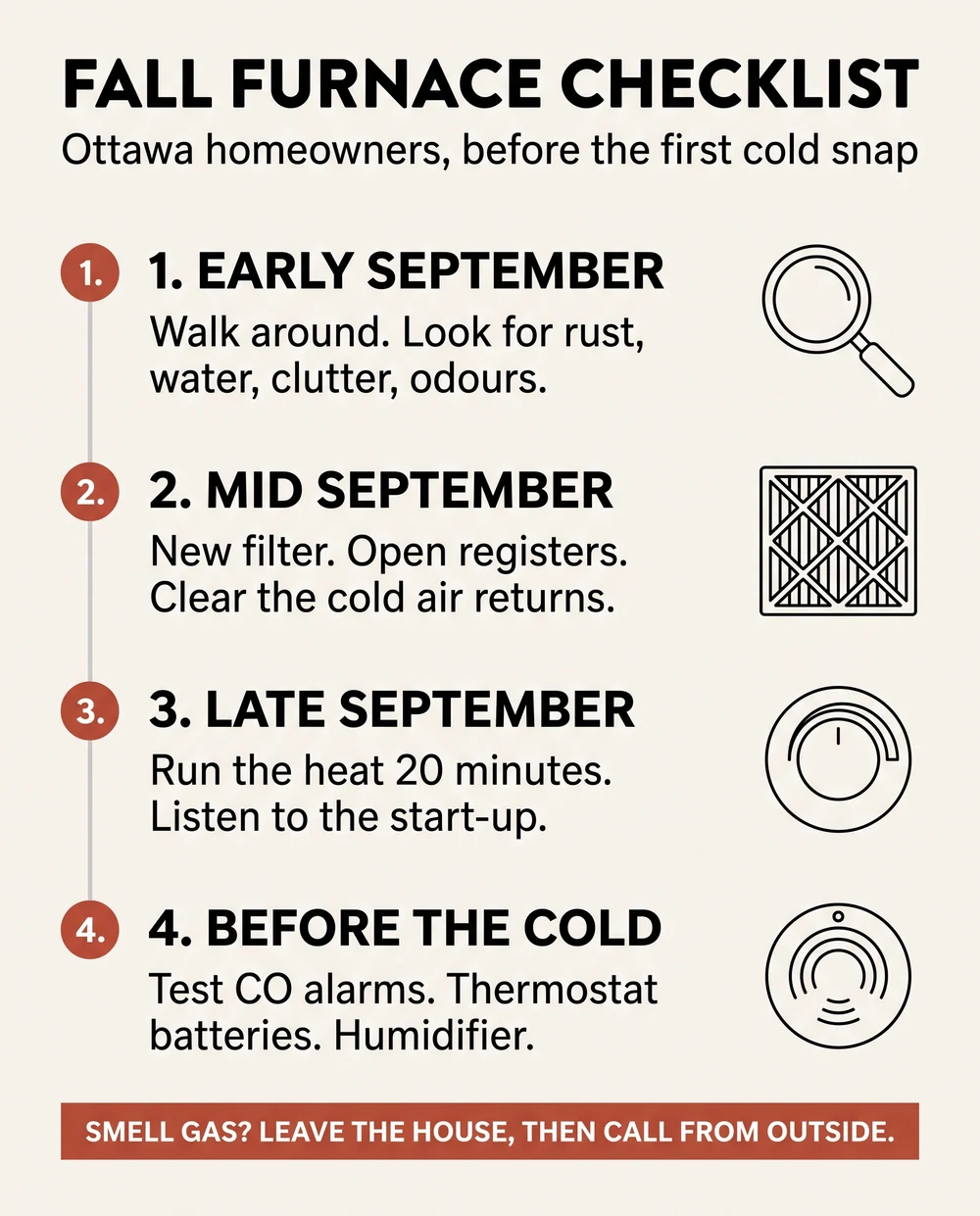
Early September: the ten minute walk-around
Go downstairs. Do not turn anything on yet. Just look.
Look at the furnace itself
You are checking for four things. Rust streaks or staining on the cabinet or the venting. Water pooling anywhere near the base. Anything stacked against the unit, which is more common than people admit, because a furnace room turns into storage in about a year. And a smell, either a sharp burnt odour or the rotten egg additive that marks a gas leak.
If you smell that rotten egg odour, stop reading. Leave the house, then call your gas utility’s emergency line from outside. That is not a maintenance issue and it is not a wait-until-Monday issue.
Check the vents outside
Walk around the house. High-efficiency furnaces vent through a pair of white plastic pipes that come out through the wall, usually low and often on a side people rarely visit. Over the summer these collect spider webs, leaves, and the odd wasp nest. Clear anything within about a foot of the openings, and while you are there make a mental note of where they are. When the snow comes, those pipes need to stay clear. A blocked exhaust is one of the more serious things that can go wrong with a modern furnace, and it is entirely preventable with a shovel.
Older mid-efficiency units vent through the chimney instead. Same idea: look for an obvious blockage, a bird nest, or crumbling masonry at the top. If something looks off up there, that is a job for someone with a ladder and a camera, not you on the roof in October.
Mid September: filter, registers, returns
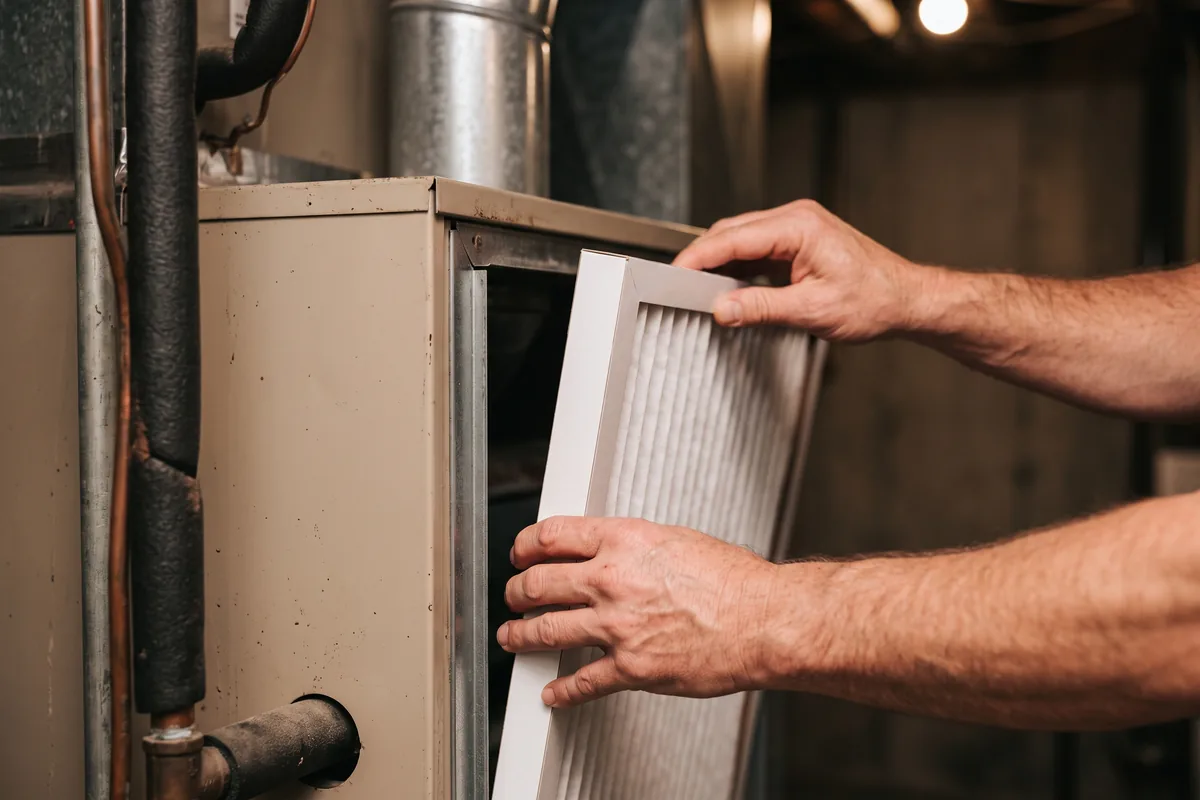
Change the filter
This is the single highest-value thing on the list and it takes four minutes. Find the slot, usually where the big return duct meets the furnace, slide the old one out, note the size printed on its cardboard frame, and put a new one in facing the same direction. There is an arrow on the frame. It points toward the furnace.
How often after that depends on what you have. A thin one inch filter generally wants changing every one to three months. A thicker four or five inch media filter typically goes six months to a year. Households with pets, allergies, or an ongoing renovation land at the short end of whatever range applies. If you pull the old one out and can barely see light through it, you waited too long, and the furnace has been working harder than it needed to all summer.
Filter choice matters more than people think. A denser filter catches more but restricts airflow, and a restriction the blower cannot overcome causes its own problems. If you are considering a serious upgrade, whole-home options like high-efficiency particle filtration are sized to the system rather than dropped into the existing slot, which is the part that gets missed.
Open the registers, clear the returns
Walk every room. Registers on the floor should be open, including in rooms nobody uses. Closing vents to “save money” does not save money on a system that was balanced for the whole house, it just raises static pressure and makes the blower fight itself.
Then find the cold air returns, the larger grilles usually on walls, and make sure nothing is parked in front of them. A couch pushed back against a return over the summer is the most common airflow problem in the city and nobody ever suspects it.
Late September: the test run
Pick a cool evening. Set the thermostat above room temperature, switch it to heat, and then go stand near the furnace and pay attention for the next twenty minutes.
What a normal start sounds like
A modern furnace runs through a sequence. A small motor spins up first to clear the exhaust. A click or a soft whoosh as the burners light. A pause of maybe half a minute. Then the main blower comes on and you feel warm air at the registers. The whole thing takes a couple of minutes and it should sound roughly the same every time.
Expect a burning-dust smell for the first ten or fifteen minutes. That is normal and it fades. What is not normal: a bang or boom on ignition, a metallic scraping, a squeal from the blower, or the unit lighting and shutting off repeatedly without ever getting the fan going. Any of those, shut it down and book someone.
Also worth doing while it runs: put your hand near a register in the room farthest from the furnace. If the air there is noticeably weaker than in the basement, you have a distribution issue worth mentioning at your next service visit.
Before the first cold snap: alarms and thermostat
Carbon monoxide alarms are the part of this list nobody enjoys and everybody should do. Ontario’s fire code has required them in homes with a fuel-burning appliance since 2015, and the province’s guidance on carbon monoxide alarms covers where they belong and how often to replace them. Press the test button on each one. Note the manufacture date on the back, because the sensors expire whether or not the unit still chirps.
Then the thermostat. If it takes batteries, change them now rather than during the first cold week. If it is programmable and you have never set a schedule, this is a decent evening to do it. And if the thing on your wall is a round dial from another era, it still works, but you are leaving comfort and efficiency on the table.
One more, and it is the easiest thing on this page: humidity. Ottawa winter air is brutally dry indoors, which is why the static shocks start in November. If your furnace has a humidifier mounted on the ductwork, its water panel and bypass damper both need attention before the season, and a lot of people forget the damper exists.
What to leave to a licensed technician
Everything above is homeowner territory. The following is not, and this is not us being precious about it. In Ontario, work on gas-fired appliances falls under a licensing regime administered by the Technical Standards and Safety Authority, and the reasons are the obvious ones.
- Anything behind the burner access panel: burners, the igniter, the flame sensor, gas valve.
- Heat exchanger inspection. Cracks in a heat exchanger are how combustion gases get into the air you breathe, and finding them takes a camera and training.
- Cleaning the blower wheel. It comes out, and putting it back wrong throws the assembly out of balance.
- Anything involving the gas line, including the connections behind a gas fireplace unit or a gas range.
- Combustion analysis and draft testing, which is the part of an annual service that actually verifies the thing is burning safely.
If your furnace has not been professionally serviced in a couple of years, book that separately from this checklist. They are not substitutes for each other. Yours catches the obvious. A proper service catches what you cannot see.
The short version
If you do nothing else this month, do these four: put in a fresh filter, clear whatever is stacked around the furnace and blocking the returns, run the heat for twenty minutes while you listen, and test the carbon monoxide alarms. That covers most of the failures we get called for in the first cold week, and it costs you the price of a filter.
The rest of it, the vent clearing and the thermostat and the humidifier, is worth doing and takes another half hour. Spread it over three weekends and you will not notice the effort. Then when the temperature falls off a cliff in late October, which it will, your house is one of the ones that just gets warm.
Take the checklist to the basement
A one-page printable version with tick boxes, so you are not scrolling on your phone beside the furnace.
Download the PDFAlexei Guiller owns Just Air HVAC and has worked in heating and cooling for more than 15 years. Questions about anything above, or want someone to look at it, call (613) 266-9742 or get in touch.
