 Proudly Canadian

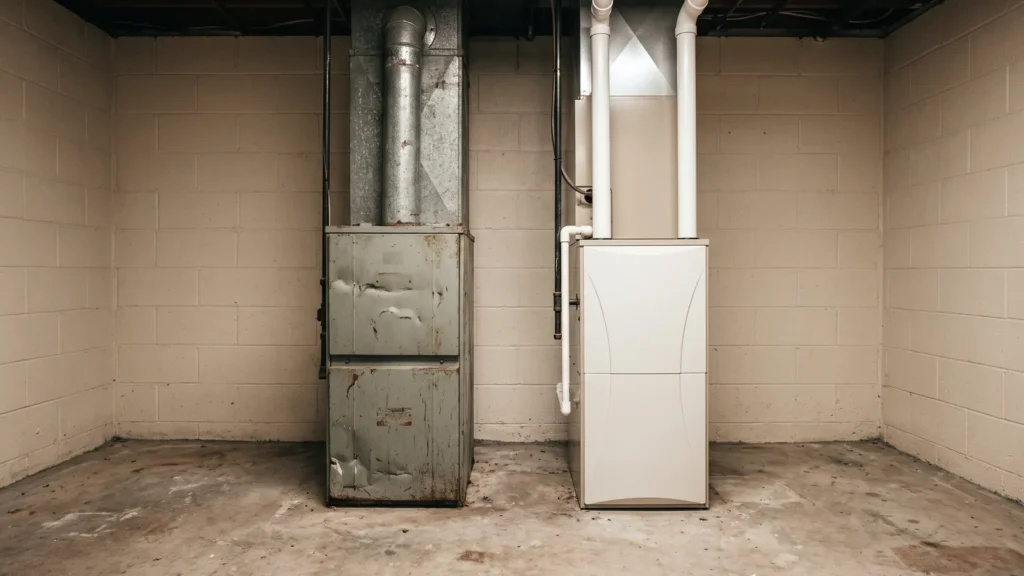
You are standing in the basement of a house you just bought, looking at a furnace with a faded sticker on the side that says 2007. Or you have lived here fifteen years and it has never given you a moment of trouble, and you are starting to wonder how much longer that lasts. Either way the question is the same, and it is the one we get asked more than any other about residential heating equipment in Ottawa.
The honest answer is annoying, so let me get it out of the way first and then explain why it is the only honest one available.
The number everyone quotes, and why it is a bad prediction
Ask five heating technicians how long a gas furnace lasts and four of them will say fifteen to twenty years. It is the industry’s standard answer and it is not wrong, exactly. It is an average. The trouble with an average is that nobody owns an average furnace.
We have pulled units out of Ottawa homes at eleven years that were genuinely finished, and we have serviced others past twenty-five that had another decade in them. The spread is enormous, and almost none of it comes down to the badge on the front. It comes down to how the thing was installed, how hard it has been made to work, and whether anyone has looked at it since the day it went in.
So treat any age number, including that one, as a prompt to start paying attention rather than a countdown clock. A furnace does not expire on a date. It degrades, and the degradation shows up in ways you can actually observe.
How to find out how old yours actually is
Before anything else, get the real number. Guessing from the house’s age is unreliable, because plenty of furnaces are second or third replacements.
Open the front panel or look along the side of the cabinet for the rating plate, a metal or foil label with the model and serial number on it. The manufacture date is encoded in the serial number, and every brand does it differently. Some spell it out. Some put the year in the first two digits, some in the last four, some use a letter code that only means anything to the manufacturer.
Two shortcuts. First, photograph the whole plate. Do not try to transcribe it. You will want the model number later anyway. Second, look for an installer’s sticker. Most companies put one on the cabinet with the install date written on it, and that tells you something the serial number cannot: when it actually started running in this house.
If neither exists, a technician can date it in about a minute during a service call. It is not worth an appointment on its own.
What actually wears a furnace out in this climate
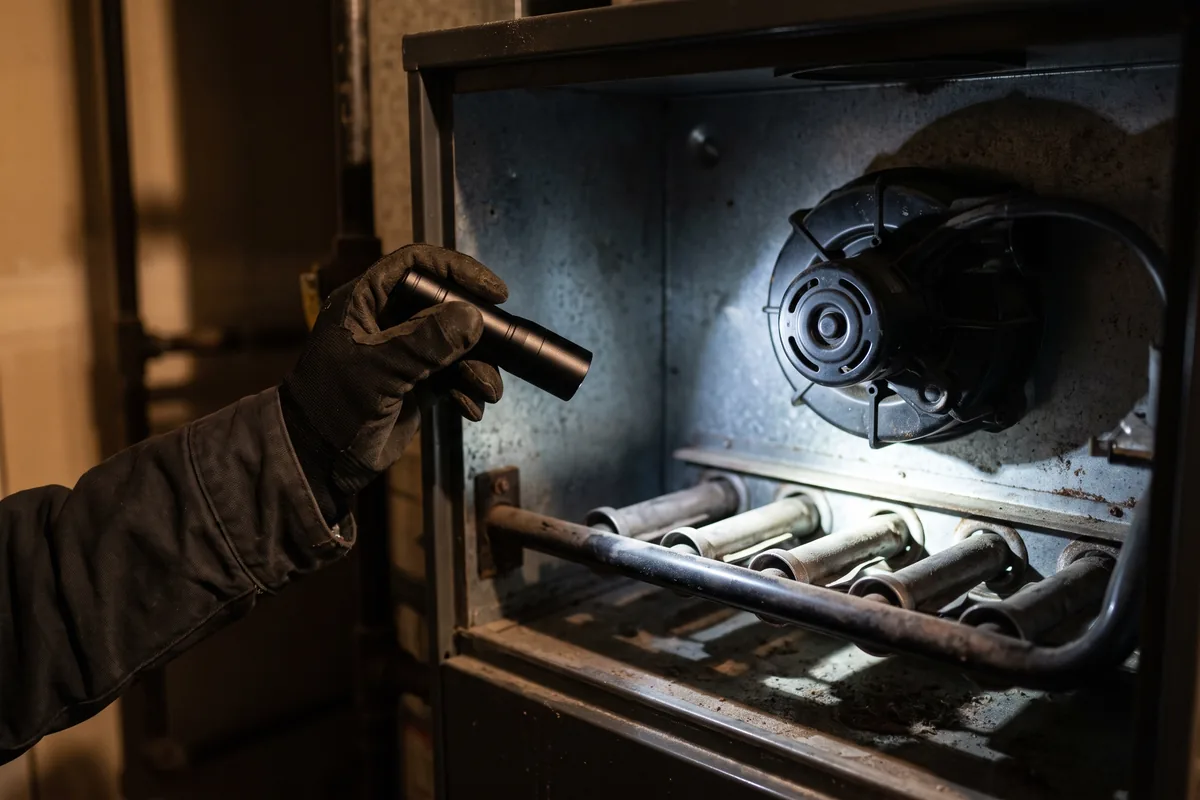
Ottawa is a hard posting for a furnace. Our heating season runs long, and the equipment here accumulates far more run hours than the same model would in Vancouver. But run hours are only part of it, and not the biggest part.
Short cycling, which usually means it is too big
This is the one that surprises people. An oversized furnace heats the house too fast, satisfies the thermostat, shuts off, and then does the whole thing again twenty minutes later. Every start and stop puts the heat exchanger through a thermal expansion cycle, and metal that expands and contracts thousands of extra times per season fatigues faster.
Oversizing was standard practice for years, partly because a bigger unit is a safer bet against a complaint call and partly because nobody was doing a proper load calculation. If your furnace runs in short bursts and your house still has cold rooms, that combination is worth investigating.
Starved airflow
A furnace is designed around a specific amount of air moving across the heat exchanger, carrying heat away. Choke that airflow and the exchanger runs hotter than intended. Filters left in for a year, undersized return ducts, closed registers, a blower wheel packed with dust: they all do the same thing, and none of them announce themselves.
This is the most preventable item on the list and the most commonly ignored. Changing a filter on schedule is genuinely one of the highest-return maintenance habits available to a homeowner.
Never having been looked at
A furnace that gets an annual service does not magically last longer because of the service itself. It lasts longer because small failures get caught while they are still small. A flame sensor going dirty, an inducer bearing starting to whine, a slightly cracked condensate line: each is a cheap fix and each becomes an expensive one if left alone through a winter.
The signs it is genuinely getting close
Age alone tells you very little. These tell you more, and they usually show up in clusters.
- Repairs are clustering. One repair in five years is normal. Three in two winters usually means components across the unit are reaching the end of their service life together, because they were all installed on the same day.
- Rooms that used to be fine are now cold. Declining output that no thermostat adjustment fixes.
- The gas bill is climbing without a rate increase or a lifestyle change. Compare against the same month in prior years, not against last month.
- It has become loud. Rattles, groans, and a blower you can hear through the floor are usually mechanical wear, and a cleaning will not touch them.
- Parts are getting hard to source. Once a technician tells you a board or a motor is on backorder or discontinued, the calculus changes, because the next failure could leave you without heat for a week.
- Rust or staining around the cabinet, venting, or base. Worth a same-week call. Do not file it under things to look at eventually.
One that belongs in its own category: if a technician tells you the heat exchanger is cracked, that is not a repair-or-replace conversation in the normal sense. A cracked exchanger is how combustion gases reach the air moving through your house, and the unit gets shut down. Get a second opinion if you want one, but get it quickly.
Where does yours sit?
This takes your install year and your recent repair history and tells you roughly which conversation you are in. It is a rule of thumb, not a diagnosis, and it cannot see your equipment.
Furnace age and condition check
A rule of thumb based on age and repair history only. It cannot see your equipment and it is not a diagnosis or a quote.
When repairing is still clearly the right call
There is a temptation, once a furnace passes some milestone birthday, to treat every fault as the beginning of the end. Resist it. A ten year old furnace with a failed igniter is a furnace with a failed igniter. Igniters are consumable. Replacing one is routine and says nothing about the rest of the machine.
The same goes for flame sensors, capacitors, pressure switches, and thermostats. These are the parts that fail first and cost least. A unit that has been maintained and is fixing one of them is not on borrowed time.
Where it shifts is when the failed part is expensive and the unit is old at the same time. A blower motor or a control board on a seventeen year old furnace is a genuine decision, because you are putting real money into something with an uncertain amount of road left. That is the point to get a written quote for both paths and compare them properly.
What to actually do with all this
If yours is under ten and has been serviced, do nothing except keep servicing it. If it is somewhere in the teens and behaving, start budgeting quietly and get an annual inspection so the failure does not arrive as a surprise in February. If it is past twenty, or if two or more of the signs above apply, it is worth getting a replacement quote while you still get to choose the timing.
That last point matters more than the technical stuff. A furnace replaced in September is a planned purchase with time to compare options and check what rebates apply. The same furnace replaced during a January cold snap is an emergency, and emergencies are expensive in ways that go beyond the invoice.
If you are heading toward replacement, efficiency ratings are worth understanding before you shop. Natural Resources Canada’s ENERGY STAR guidance for Canadian households explains what the certification actually covers, and it is a better starting point than a sales brochure. It is also worth checking which heating rebates currently apply before you commit, since the programs change and the amounts move.
Furnace age and condition worksheet
A printable sheet to record the model, serial and install date off the rating plate, plus the signs to check for. Handy to keep beside the furnace.
Download the PDFAlexei Guiller owns Just Air HVAC and has worked in heating and cooling for more than 15 years. Questions about anything above, or want someone to look at it, call (613) 266-9742 or get in touch.
