 Proudly Canadian

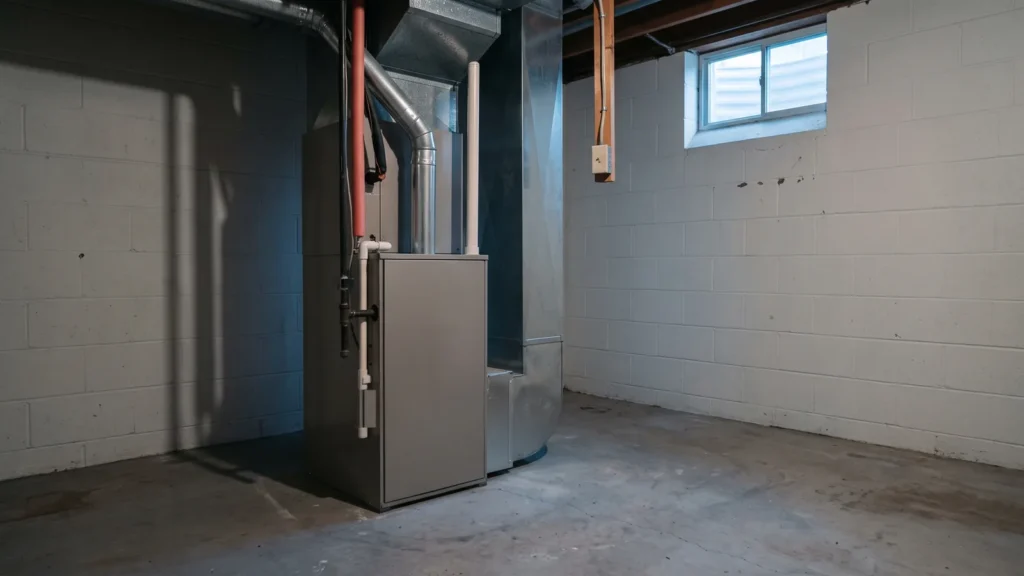
A decent share of the no-heat calls we take turn out to be something the homeowner could have sorted out in ten minutes. Not because anybody did anything wrong, but because the things that stop a furnace most often are switches, filters and panels, and nobody thinks to look at those first. Before you book anything, including with us, work through the nine checks below. If none of them does it, at least you can tell whoever comes out to your furnace and heating system exactly what you already ruled out, and that shortens the visit.
First, the four situations where you stop and get out
None of the checks below apply if any of these are true. This part is not a judgement call.
- You smell gas. That sulphur or rotten egg smell is an additive put in specifically so you notice it. Do not flip switches, do not use your phone indoors. Get everyone out, then call your gas utility’s emergency line from outside.
- A carbon monoxide alarm is sounding. Same response. Outside first, emergency services second. Ontario’s official carbon monoxide guidance is worth reading on a calm day, not this one.
- You see or smell burning, or there is smoke. Kill the power at the furnace switch if you can reach it safely, and get out if it is anything more than a faint smell.
- There is standing water around the unit. Do not stand in it and start pushing buttons. Cut the power at the breaker and deal with the water first.
Still here? Good. Work down the list in order, because it runs from most common to least.
The nine checks
1. The thermostat, properly
Yes, obviously. But check it properly. Is it set to HEAT and not to COOL or OFF? Is the setpoint at least three degrees above the current room reading, because a one degree gap may not be enough to trigger a call for heat? Is the screen blank or dim, which usually means dead batteries? Is it running a schedule you forgot about that has it set back to sixteen degrees at this hour?
Change the batteries even if you are not sure they are the problem. It is a two dollar test.
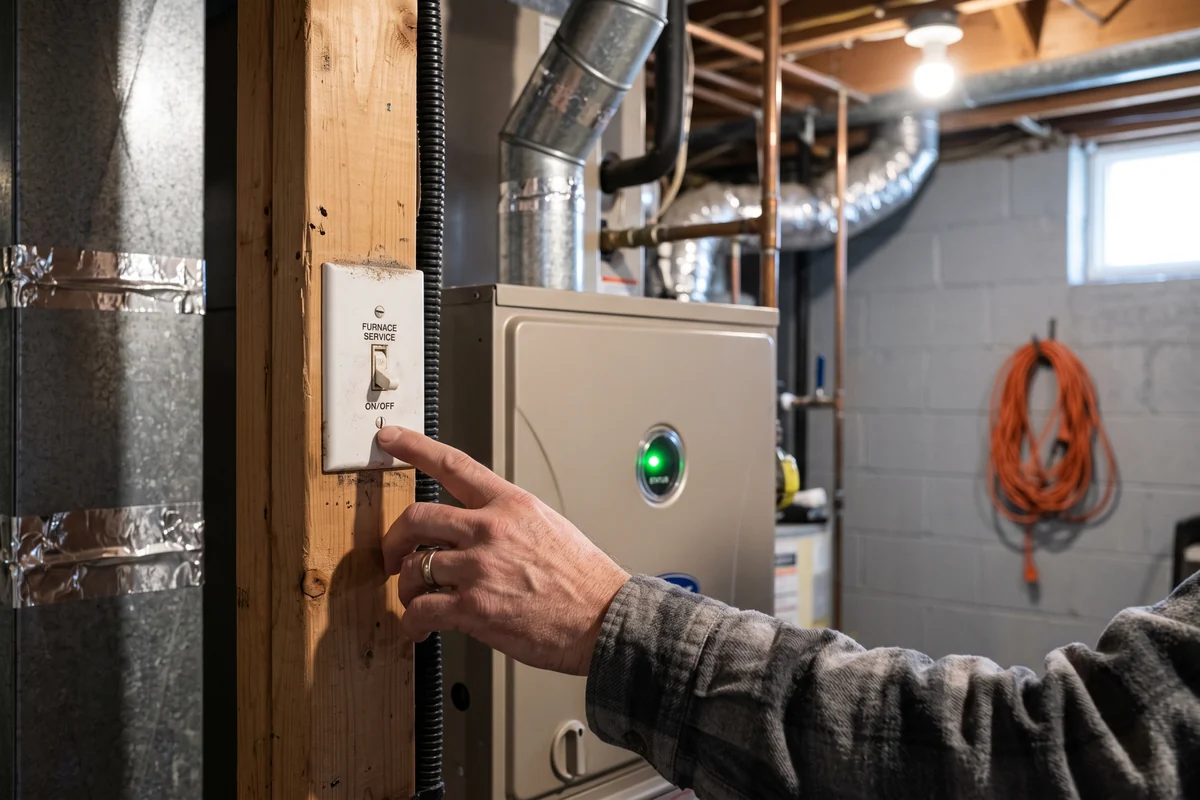
2. The switch on the wall that looks like a light switch
There is a service switch near the furnace, usually mounted on a nearby joist or wall, and it looks exactly like an ordinary light switch. Sometimes it has a red faceplate. Often it does not.
People flip it looking for a basement light. Cleaners flip it. Anyone doing work down there flips it. This is genuinely one of the most common causes of a furnace that is completely dead, and it embarrasses people enough that they do not admit it, which is why nobody warns you about it.
3. The breaker
Go to the panel and find the furnace breaker. A tripped breaker is not always obviously between positions. Push it firmly all the way to OFF, then back to ON.
If it trips again, stop there. A breaker that trips repeatedly is protecting you from something, and resetting it over and over is how a nuisance turns into a fire. That one is a call.
4. Gas supply to the appliance
Two things here, both non-invasive. First, is anything else gas-fired in the house working? If your stove and water heater are fine, gas is reaching the building. Second, look at the shutoff valve on the pipe feeding the furnace. When the handle sits in line with the pipe, it is open. Crossways means closed.
Look, do not adjust. If that valve is closed and you did not close it, somebody closed it for a reason. Find out what it was before opening it.
5. The filter
Pull it out and hold it up to a light. If light barely gets through, that is your problem or a large part of it. A blocked filter starves the blower, the unit overheats, and a safety limit switch shuts it down. It will often run for a few minutes and then quit, over and over.
Put a clean one in the same way round, arrow pointing toward the furnace. If overheating was the cause, the unit may need twenty or thirty minutes to cool before it will restart.
6. The front panel and the door switch
Behind the removable front panel there is a small plunger switch that only lets the furnace run when the door is properly closed. If you or anyone else took that panel off, for a filter change or anything else, and put it back slightly crooked, the furnace will not start and will give you no clue why.
Take the panel off and reseat it firmly. Make sure it sits flush and any latches or screws are engaged.
7. The condensate drain
High-efficiency furnaces make water when they run, quite a lot of it, and that water leaves through a small plastic tube to a floor drain or a condensate pump. When the tube clogs or the pump fails, water backs up, a float switch trips, and the furnace shuts itself off to avoid flooding your basement.
Look for water where it should not be, a full condensate pump reservoir, or a pump that is silent when it should be cycling. Some pumps have a reset. If you find standing water in the pump and it is not clearing, that is a service call, and it is usually a quick one.
8. The vents outside
This one is specific to Ottawa winters and it catches people every year. High-efficiency furnaces vent through a pair of white plastic pipes that come out low on an exterior wall. Snow drifts, ice from a dripping eave, or a plow bank against the house can block them. The furnace detects that it cannot exhaust properly and refuses to run, which is exactly what you want it to do.
Go out and look. Clear snow and ice back by a good arm’s length. Use your hands or a soft brush and nothing sharp, because those pipes crack and a cracked flue is a much bigger problem than the one you started with.
9. The status light
Nearly every furnace built in the last twenty-odd years has a small LED visible through a viewing window on the front panel, and it blinks a pattern that means something specific. Two short flashes, three long, steady green, rapid red: each maps to a fault code.
The legend is usually printed on the inside of the panel you just took off in check six. Read the pattern, count the flashes carefully, and write it down. Even if it means nothing to you, it means a great deal to the technician, and it is the single most useful thing you can have ready when you call.
Symptom to likely cause, at a glance
| What it is doing | Where to look first | Yours or ours |
|---|---|---|
| Completely dead, no lights, no sound | Service switch, breaker, front panel not seated | Usually yours |
| Blower runs constantly, air is cool | Thermostat fan set to ON instead of AUTO | Yours |
| Starts, runs a few minutes, shuts off, repeats | Blocked filter, closed registers, blocked vents outside | Start yours, then ours |
| Tries to light, clicks, gives up | Igniter, flame sensor, gas supply | Ours |
| Dead after a filter change or basement work | Door switch, service switch | Yours |
| Water pooling near the unit | Condensate drain or pump, float switch tripped | Often ours |
| Breaker trips again after resetting | Do not reset a third time | Ours, promptly |
| Banging or booming when it lights | Shut it down | Ours, same day |
When to stop working the list and pick up the phone
Stop if the breaker trips a second time. Stop if the unit lights and then bangs. Stop if you have gone through all nine and it still will not run, because past this point the likely candidates are the igniter, the flame sensor, the pressure switch, the inducer motor or the control board, and every one of those sits behind the burner compartment.
That is not a boundary we invented to protect the trade. Gas-fired appliance work in this province falls under the licensing regime run by the Technical Standards and Safety Authority, and it is one of the few areas where the rule genuinely tracks the risk. A wrong move in there is a combustion problem, and combustion problems are the ones that hurt people.
If you are without heat overnight in real cold, treat it as urgent regardless of what the list said. Frozen pipes turn a repair bill into a renovation, and you can reach our Ottawa team any hour for exactly this reason.
Have these four things ready when you call
It genuinely speeds things up, and occasionally it means the right part arrives on the first visit rather than the second.
- The brand and model number off the rating plate. A photo is fine.
- The status light pattern from check nine.
- Which of the nine checks you already did.
- Roughly when it stopped, and whether anything happened around the same time. A power flicker, a filter change, a plumber in the basement.
One last thing, and it is the least satisfying advice on this page: most of the failures on this list are preventable. Filters, clear vents, an annual look at the burner side. The nine checks are worth knowing, but the goal is a winter where you never need them.
The nine checks, printable
Print it and put it near the furnace now, while you have heat. It is a bad list to go looking for at 11pm in February.
Download the PDFAlexei Guiller owns Just Air HVAC and has worked in heating and cooling for more than 15 years. Questions about anything above, or want someone to look at it, call (613) 266-9742 or get in touch.
